Chess Puzzles PDF: A Comprehensive Guide
Chess Puzzle PDFs offer a focused training method, compiling tactical and strategic challenges for players of all levels. These digital resources provide convenient, portable access to a wealth of chess problems, enhancing skill development.
What are Chess Puzzle PDFs?
Chess Puzzle PDFs are digital documents, typically in the Portable Document Format, that contain collections of chess problems designed to test and improve a player’s tactical and strategic understanding. These PDFs consolidate various puzzle types, ranging from simple mate-in-one scenarios to complex endgame studies and combinational motifs.
They often feature diagrams of chess positions, posing a specific challenge – such as finding the best move or a sequence of moves – to achieve a desired outcome. Resources like Chess Evolution: 551 Puzzles by Csaba Balogh and compilations from the Internet Archive demonstrate the breadth of content available.
These PDFs are created from practical games, tournament positions, or are specifically composed for instructional purposes. They offer a self-contained, offline method for chess training, making them accessible anywhere with a PDF reader.
Why Use Chess Puzzle PDFs?
Chess Puzzle PDFs provide a highly effective and convenient method for improving chess skills. Unlike relying solely on online platforms, PDFs offer offline access, allowing practice anytime, anywhere, without needing an internet connection. They are particularly useful for focused training, eliminating distractions present in online environments.
Using PDFs like Everyman Chess: Practical Chess Puzzles (600 Puzzles) helps players develop crucial analytical skills. They encourage deliberate practice, forcing players to calculate variations and evaluate positions independently.
Furthermore, PDFs often present puzzles categorized by difficulty, enabling players to progressively challenge themselves. Resources like the Reddit/r/chess Mate in 2 Puzzles PDF offer focused training on specific tactical themes. Consistent use of these resources enhances pattern recognition, calculation speed, and overall chess understanding.

Popular Chess Puzzle PDF Resources
Numerous chess puzzle PDFs are available, ranging from collections of tactical problems to endgame studies. Chess Evolution, Everyman Chess, and the Internet Archive are excellent sources.
Chess Evolution: 551 Puzzles by Csaba Balogh
Csaba Balogh’s Chess Evolution: 551 Puzzles presents a substantial collection of tactical challenges drawn from practical games played in 2016. This resource is designed to sharpen your calculation skills and pattern recognition. The puzzles aren’t artificially constructed; instead, they originate from real-world game situations, offering a more authentic training experience.
The book features a responsible editor, Csaba Balogh, and a cover/typesetting design by Piotr Pielach of i-press.pl. It was first published in 2017. The focus is on providing puzzles that reflect the complexities and nuances found in actual play, making it a valuable tool for players looking to improve their performance in competitive settings.
Chess Evolution aims to help players develop a deeper understanding of tactical motifs and improve their ability to spot winning opportunities. The sheer volume of puzzles ensures a diverse range of challenges, preventing rote memorization and encouraging genuine problem-solving skills. It’s a comprehensive resource for dedicated chess enthusiasts.
Everyman Chess: Practical Chess Puzzles (600 Puzzles)
Everyman Chess’s Practical Chess Puzzles, containing 600 puzzles, is specifically geared towards improving a player’s analytical abilities. A key strength of this book lies in its detailed commentary accompanying each puzzle. The author explains the thought process behind the solutions, outlining the options considered during the game and the reasoning for choosing a particular line.
This approach is particularly beneficial for beginner to intermediate players who are learning how to analyze positions effectively. It’s not simply about finding the correct move; it’s about understanding why that move is correct. The puzzles themselves are sourced from recent tournaments, ensuring relevance and a realistic level of difficulty.
By studying these annotated games and puzzles, players can develop a more systematic and insightful approach to game analysis, ultimately leading to improved decision-making on the chessboard. It’s a practical guide to mastering the art of chess calculation.
Reddit/r/chess Mate in 2 Puzzles PDF
The r/chess community on Reddit provides a readily available PDF compilation of “Mate in 2” puzzles. This collection, sourced directly from posts within the r/chess subreddit, offers a quick and engaging way to sharpen tactical vision. The PDF, compiled by chessvision.ai, gathers 18 popular examples of forced checkmates in two moves.
Each puzzle diagram is accompanied by the original post’s title and a direct link back to the source on Reddit. This allows solvers to explore the discussion surrounding each puzzle and gain further insights from other chess enthusiasts. It’s a dynamic resource, constantly updated with new contributions from the community.
This PDF is an excellent choice for players looking for bite-sized tactical challenges and a connection to the vibrant online chess community. It’s a fun and accessible way to practice pattern recognition and calculation skills.
Internet Archive: Chess Puzzle Book Compilation
The Internet Archive hosts a valuable compilation of chess puzzle books in PDF format, offering a treasure trove for enthusiasts. This collection provides free access to numerous classic and specialized puzzle resources, spanning various difficulty levels and thematic focuses. Notable titles include “Blokh, Combinational Motifs.pdf” (19.7M), focusing on tactical patterns, and “Burgess, The Gambit Book of Instructive Chess Puzzles.pdf” (4.9M), designed for learning through examples.
Further enriching the archive are “Coello, Problemas de Ajedrez ‒ Temas modernos.pdf” (13.1M), exploring modern puzzle themes, and “Csaba, 365 Greatest Puzzles.pdf” (10.9M), offering a year-long supply of challenges. These PDFs represent a diverse range of puzzle styles and complexities.
The Internet Archive provides a convenient platform for discovering and downloading these resources, making them readily available for offline study and practice. It’s a fantastic resource for players seeking to expand their puzzle-solving repertoire.
Blokh, Combinational Motifs.pdf
“Blokh, Combinational Motifs.pdf”, available on the Internet Archive, is a highly regarded resource for intermediate to advanced chess players. This PDF focuses intensely on recognizing and exploiting common tactical motifs – the building blocks of combinations. It doesn’t present puzzles in isolation, but rather categorizes them by the underlying tactical idea, such as pins, forks, skewers, and discovered attacks.
The book’s strength lies in its systematic approach. By studying puzzles grouped by motif, players develop a deeper understanding of why a tactic works, not just how to spot it. This leads to improved pattern recognition and a greater ability to generate combinations independently.
With a file size of 19.7M, this PDF is a substantial collection, offering extensive training material. It’s an excellent choice for those aiming to elevate their tactical vision and combinational play.
Burgess, The Gambit Book of Instructive Chess Puzzles.pdf
“Burgess, The Gambit Book of Instructive Chess Puzzles.pdf”, found on the Internet Archive, is a valuable resource for players seeking to improve their tactical understanding. With a file size of 4.9M, this PDF presents a curated collection of puzzles designed to be genuinely instructive, going beyond simple tactical tricks.
The puzzles are carefully selected to illustrate important chess principles and common tactical themes. The emphasis is on understanding the underlying ideas and learning from mistakes, rather than just finding the correct move. This approach fosters a deeper comprehension of chess strategy and tactics.
This book is particularly helpful for players who want to develop their analytical skills and learn how to evaluate positions effectively. It’s a solid choice for those looking to build a strong foundation in tactical chess.
Coello, Problemas de Ajedrez — Temas modernos.pdf
“Coello, Problemas de Ajedrez ‒ Temas modernos.pdf”, available through the Internet Archive, offers a collection of chess puzzles focusing on modern themes and ideas. This PDF, weighing in at 13.1M, presents a diverse range of problems designed to challenge players and expand their tactical horizons.
The puzzles likely explore contemporary tactical motifs and strategic concepts prevalent in modern chess. Expect to encounter problems that require a good understanding of dynamic play, piece coordination, and positional nuances. The collection aims to move beyond classical puzzle types, offering a fresh perspective.
This resource is particularly suited for intermediate to advanced players looking to refine their tactical vision and stay abreast of current trends in chess problem composition. It’s a valuable addition to any serious chess player’s study materials.
Csaba, 365 Greatest Puzzles.pdf
“Csaba, 365 Greatest Puzzles.pdf”, hosted on the Internet Archive, is a substantial collection of chess puzzles compiled by Csaba Balogh. Weighing 10.9M, this PDF promises a year’s worth of tactical challenges, offering a puzzle for each day of the year. It’s a comprehensive resource for players seeking consistent training.
The puzzles are likely selected for their instructive value and represent a wide range of tactical themes. Expect to encounter combinations, endgame studies, and positional problems that test your calculation skills and strategic understanding. The “greatest” designation suggests a focus on quality and elegance.
This PDF is ideal for players of all levels, providing a structured approach to puzzle solving. Regular engagement with these puzzles will undoubtedly improve your tactical vision and overall chess proficiency. It’s a fantastic resource for dedicated chess learners.
Difficulty Levels in Chess Puzzle PDFs
Chess Puzzle PDFs cater to all skill levels, ranging from beginner-friendly exercises to incredibly complex challenges for masters. Selecting appropriate difficulty is crucial for effective learning.
Beginner Chess Puzzles
Beginner Chess Puzzles within PDFs typically focus on fundamental tactical motifs, introducing players to the core building blocks of chess strategy. These puzzles often involve Mate in One scenarios, allowing new players to quickly grasp the concept of delivering checkmate.
Expect simple Forks, Pins, and Skewers, presented in clear diagrams with minimal pieces on the board. The goal is to develop pattern recognition and the ability to calculate one or two moves ahead. PDFs designed for beginners often include explanations of the solutions, detailing the reasoning behind the correct move.
These introductory puzzles avoid complex variations and focus on direct, tactical wins. Resources like introductory puzzle books and collections specifically labeled for beginners are excellent starting points. Successfully solving these puzzles builds confidence and lays the foundation for tackling more challenging problems later on. The emphasis is on understanding basic principles rather than deep calculation.
Intermediate Chess Puzzles
Intermediate Chess Puzzles in PDF format build upon foundational tactics, demanding more calculation and strategic foresight. These puzzles frequently present Mate in Two scenarios, requiring players to visualize a sequence of moves. Expect more complex Forks, Pins, and Skewers, often interwoven with defensive threats from the opponent.
Intermediate PDFs introduce combinations involving multiple tactical ideas, forcing players to prioritize and evaluate different options. Positional elements begin to play a larger role, requiring assessment of pawn structures and piece activity. Solutions may involve sacrificing material for a decisive attack or gaining a significant positional advantage.
These puzzles often require 3-5 move calculations and a deeper understanding of chess principles. Resources like “Practical Chess Puzzles” by Everyman Chess offer well-annotated examples. Successfully navigating these challenges enhances pattern recognition and improves the ability to formulate plans.
Advanced Chess Puzzles
Advanced Chess Puzzles, often found in PDFs like “Combinational Motifs” by Blokh, demand exceptional calculation skills and a profound understanding of positional nuances. These puzzles frequently involve complex combinations spanning 5+ moves, requiring precise visualization and anticipation of opponent responses.
Expect intricate tactical motifs, including sacrifices, interferences, and deflection, often masked by subtle positional considerations. Endgame Studies become prevalent, testing deep understanding of king activity, pawn promotion, and zugzwang. Solving these puzzles necessitates a mastery of chess principles and the ability to identify critical imbalances.
Advanced PDFs often present puzzles with multiple solutions or deceptive lines, challenging players to find the most efficient and elegant approach. Resources like Csaba Balogh’s “365 Greatest Puzzles” provide a rigorous test of chess ability, pushing players to their limits.

Types of Chess Puzzles Found in PDFs
Chess Puzzle PDFs commonly feature Mate in One and Mate in Two problems, alongside tactical exercises focusing on Forks, Pins, and Skewers, plus challenging Endgame Studies.
Mate in One Puzzles
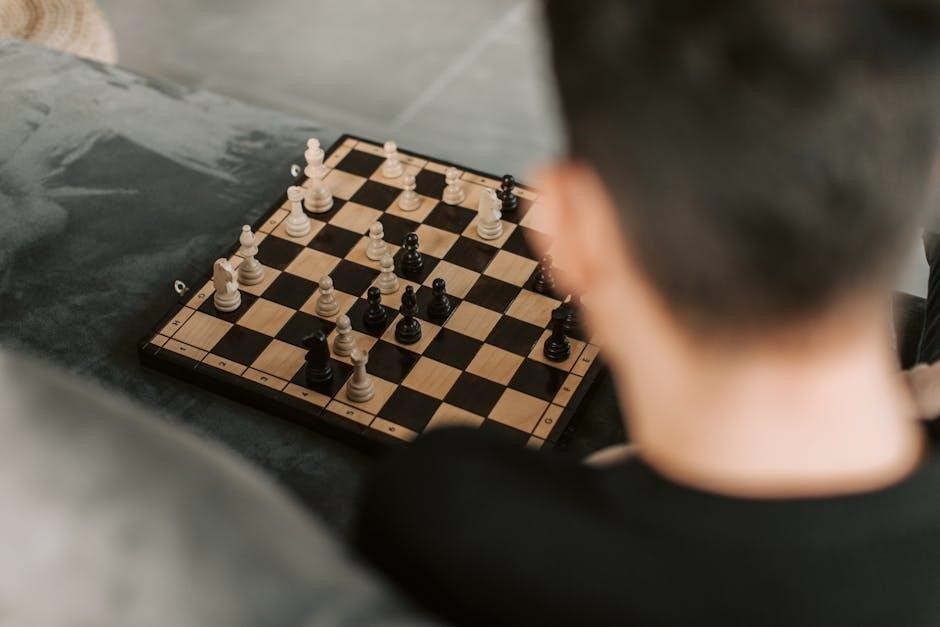
Mate in One Puzzles are foundational exercises within Chess Puzzle PDFs, designed to sharpen a player’s immediate tactical vision. These puzzles present positions where White or Black can deliver checkmate in a single move. They are excellent for beginners, building pattern recognition and the ability to quickly identify winning opportunities.
Solving these puzzles isn’t just about finding *a* checkmate; it’s about finding the *only* checkmate. This forces precise calculation and eliminates wasted moves. Many Chess Puzzle PDFs, like those compiled from r/chess on Reddit, dedicate sections to these quick-win scenarios.
The benefit extends beyond simply recognizing the pattern. Regularly solving Mate in One puzzles improves your scanning ability during a real game, allowing you to spot immediate threats and opportunities that might otherwise be missed. They are a crucial stepping stone to more complex tactical combinations.
Mate in Two Puzzles
Mate in Two Puzzles, frequently found within Chess Puzzle PDFs, represent a step up in complexity from single-move checkmates. These puzzles require players to calculate a forced sequence of two moves, culminating in checkmate. They demand a greater degree of foresight and an understanding of how pieces interact.
These puzzles aren’t always immediately obvious; often, they involve a sacrifice or a subtle repositioning of pieces to create the mating threat. Resources like the Reddit/r/chess Mate in 2 Puzzles PDF specifically focus on this puzzle type, offering a curated collection for practice.
Successfully solving Mate in Two puzzles builds crucial calculation skills. Players learn to visualize future positions, anticipate opponent responses, and confirm the inevitability of checkmate. This skill translates directly into improved game play, allowing for more accurate tactical assessments and confident decision-making.
Tactical Motifs (Forks, Pins, Skewers)
Chess Puzzle PDFs are invaluable for mastering fundamental tactical motifs like forks, pins, and skewers. These patterns frequently appear in practical games, and recognizing them quickly is crucial for success. Burgess, The Gambit Book of Instructive Chess Puzzles, available on the Internet Archive, likely contains numerous examples illustrating these concepts.
A fork attacks two or more pieces simultaneously, while a pin restricts a piece’s movement by threatening a more valuable piece behind it. A skewer attacks a valuable piece, forcing it to move and revealing an attack on a less valuable piece behind it.
Puzzle collections dedicated to tactical motifs help players develop pattern recognition. Repeated exposure to these scenarios trains the eye to spot opportunities during a game. Consistent practice with Chess Puzzle PDFs significantly improves tactical vision and calculation ability, leading to more decisive play.
Endgame Studies
Chess Puzzle PDFs often include endgame studies – meticulously crafted positions designed to test precise calculation and understanding of endgame principles. These aren’t simply about checkmating; they explore subtle nuances of pawn structure, king activity, and piece coordination. Resources like the Internet Archive, featuring books such as Blokh, Combinational Motifs, may contain complex endgame scenarios.
Solving endgame studies enhances a player’s ability to convert advantages in the final phase of the game. They demand deep calculation, often several moves ahead, and a thorough grasp of theoretical endgames.
Unlike tactical puzzles focused on immediate attacks, endgame studies require patience and a strategic mindset. Regularly working through these puzzles in Chess Puzzle PDFs builds resilience, improves positional understanding, and refines endgame technique, ultimately leading to more successful results.
Utilizing Chess Puzzle PDFs for Improvement
Chess Puzzle PDFs are powerful tools for growth! Consistent solving, tracking progress, and integrating with platforms like Lichess or Chess.com maximizes learning.
Solving Techniques
Effective puzzle solving demands a systematic approach. Begin by carefully scanning the board, identifying immediate threats and potential weaknesses in both positions. Don’t rush – allocate sufficient time for thorough calculation. Prioritize forcing moves like checks, captures, and threats, as these limit your opponent’s responses and simplify analysis.
Visualization is crucial; mentally rehearse move sequences before physically moving pieces. Look for tactical motifs such as forks, pins, skewers, and discovered attacks. Consider candidate moves, evaluating their consequences several moves deep. If stuck, try working backward from the desired outcome – the checkmate or material gain.
Resist the temptation to guess. Every move should be based on concrete calculation, not intuition. Chess Puzzle PDFs are most beneficial when approached with discipline and a willingness to learn from mistakes. Reviewing solutions, even those you solved correctly, reveals alternative approaches and deeper understanding.
Tracking Progress
Consistent progress tracking is vital when utilizing Chess Puzzle PDFs. Maintain a record of puzzles attempted, solved, and those requiring assistance. Note the time taken for each puzzle – a decreasing solve time indicates improving tactical vision and calculation speed. Categorize puzzles by type (mate-in-one, mate-in-two, endgame studies) to identify areas of strength and weakness.
Regularly review previously solved puzzles to reinforce patterns and prevent regression. Analyze errors to understand the underlying reasons for miscalculations. Consider using a spreadsheet or dedicated chess training app to log your performance and visualize improvement over time.
Setting realistic goals, such as solving a certain number of puzzles per day or week, fosters discipline and motivation. Chess Puzzle PDFs become more effective when combined with a structured approach to monitoring and evaluating your development.
Integrating with Online Platforms (Lichess, Chess.com)
Chess Puzzle PDFs can powerfully complement online chess training platforms like Lichess and Chess.com. Use PDFs for focused, offline study of specific tactical motifs or endgame techniques. Then, apply these concepts in online puzzle rush modes or rated puzzle solving to test your understanding in a dynamic environment.
Analyze games played online and identify tactical opportunities missed. Seek out similar puzzle patterns in your PDF collection to reinforce learning. Some platforms allow puzzle creation; recreate challenging PDF puzzles online for repeated practice.
The combination offers a balanced approach: PDFs provide deliberate practice, while online platforms offer immediate feedback and adaptive difficulty; This synergy accelerates improvement and solidifies tactical skills.
Creating Your Own Chess Puzzle PDF
Crafting personalized chess puzzle PDFs involves selecting intriguing positions, utilizing software for diagram creation, and compiling them into a formatted document for focused training.
Software Options
Numerous software solutions cater to creating chess puzzle PDFs, each offering unique features. For diagram generation, Chess Diagram Editor and Scid vs. PC are popular choices, allowing precise board setup and notation. More advanced options include ChessBase, a comprehensive database program with robust diagramming capabilities, though it comes with a steeper learning curve and cost.
LaTeX, a typesetting system, provides exceptional control over formatting and is favored by those seeking professional-looking PDFs. However, it requires familiarity with its coding language. Simpler alternatives like Microsoft Word or Google Docs can be used for basic puzzle arrangement, but may lack the specialized features of dedicated chess software.
Furthermore, online tools such as ChessVision can assist in puzzle creation and PDF compilation, offering a streamlined workflow. The best software depends on your technical skill, budget, and desired level of customization.
Sourcing Puzzle Material
Finding high-quality puzzle content is crucial for an effective PDF. Existing chess books are a prime source; however, copyright considerations apply. Websites like Lichess and Chess.com offer vast puzzle databases, though direct extraction may be restricted by terms of service.
Reddit’s r/chess community, as demonstrated by the “Mate in 2” compilation, provides user-submitted puzzles, but verifying their correctness is essential. The Internet Archive hosts numerous public domain chess puzzle books, offering a legal and readily available resource.
Tournament game databases can be mined for tactical opportunities, requiring analysis to isolate instructive positions. Creating original puzzles demands strong chess understanding and composition skills. Remember to always credit sources appropriately when compiling your PDF.
PDF Compilation and Formatting
Creating a polished PDF involves careful arrangement and presentation. Software options range from Microsoft Word and Google Docs (with PDF export) to dedicated publishing tools like Adobe InDesign. Ensure clear diagram presentation; use standard algebraic notation and high-resolution images.
Consistent formatting is key – choose a readable font, appropriate spacing, and a logical puzzle order (by difficulty, theme, etc.). Include solutions at the end, clearly separated from the puzzles themselves. Consider adding an introduction explaining the PDF’s scope and intended audience.
Metadata (title, author, keywords) improves searchability. Finally, compress the PDF to reduce file size without sacrificing quality, ensuring easy distribution and accessibility for all chess enthusiasts.
Be First to Comment